An October 2026 analysis of 500 published grid engineering jobs reveals a senior-heavy hiring market, limited entry-level flexibility, and a sharp divide in remote opportunities across engineering disciplines.
Published October 8, 2026 | Original Research by Grid Talent Hub
The U.S. electric grid needs engineers who can design substations, model power systems, protect transmission infrastructure, and integrate new energy resources.
But what does the hiring market actually look like for engineers entering these specialized fields?
To find out, Grid Talent Hub analyzed 500 published job listings from 121 employers represented on its specialized power engineering job board.
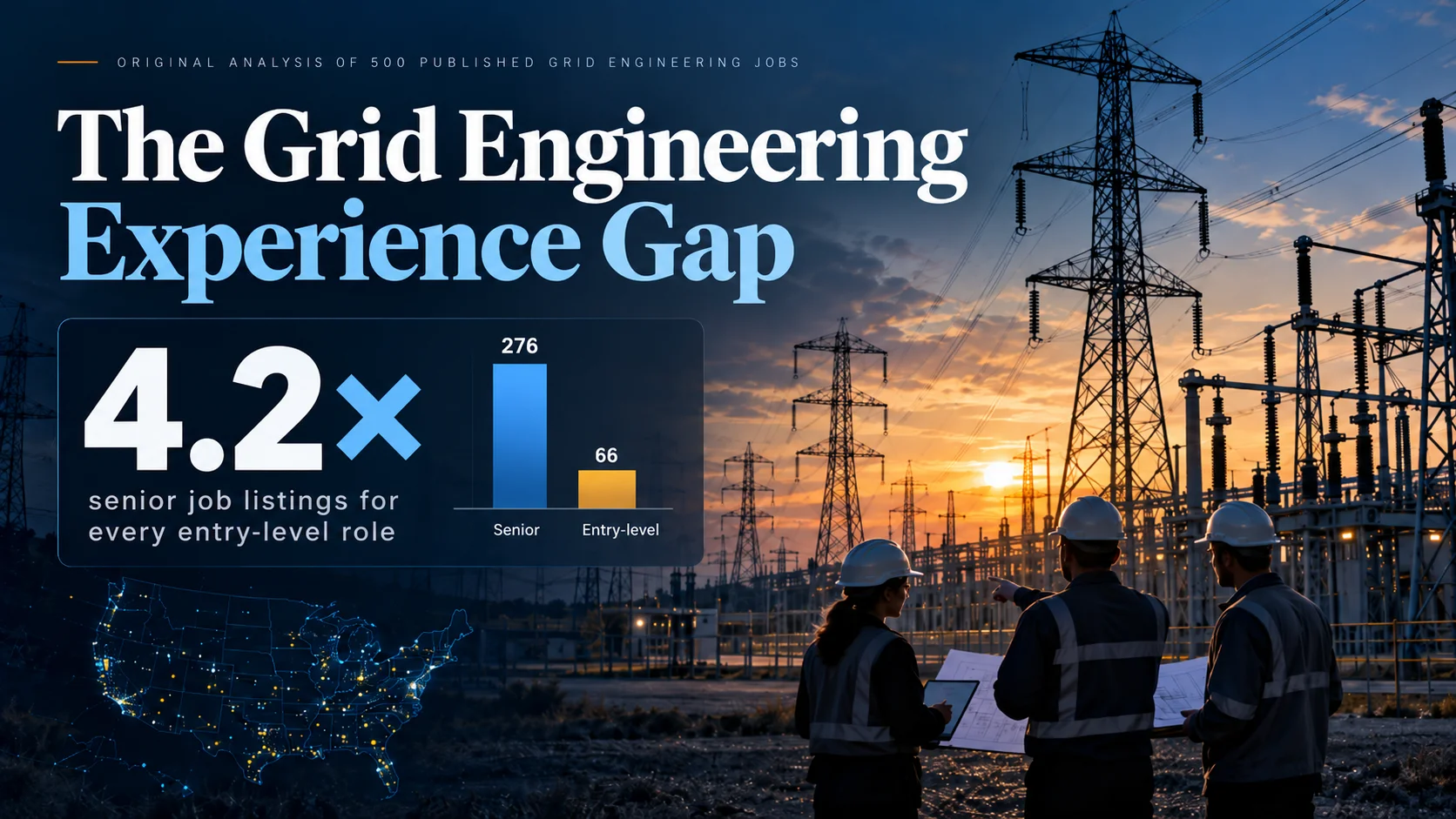
The most striking finding: senior-level listings outnumber entry-level listings by more than four to one.
The data also reveals that remote work is concentrated among experienced professionals, while entry-level candidates face a predominantly on-site job market.
These findings offer a snapshot of hiring patterns among employers represented in the dataset—not a measurement of every available grid engineering job nationwide.
1. More than half of listed jobs target senior talent
Of the 500 published listings analyzed, 276 were categorized as senior-level positions. Just 66 were classified as entry-level.
Seniority | Listings | Share |
|---|---|---|
Senior | 276 | 55.2% |
Mid-level | 134 | 26.8% |
Entry-level | 66 | 13.2% |
Associate | 23 | 4.6% |
Director | 1 | 0.2% |
Total | 500 | 100% |
That represents approximately 4.2 senior listings for every entry-level listing.
Even when entry-level and associate positions are combined, senior listings outnumber these earlier-career opportunities by approximately 3.1 to one.
Could this simply reflect the hiring practices of one unusually active employer?
Not entirely.
After excluding the five companies with the most published listings, 49.8% of the remaining 271 positions were still classified as senior, compared with 14.0% entry-level.
The senior-heavy pattern therefore persists beyond the largest employers in this sample.
Why this matters
Grid engineering requires highly specialized experience in areas such as transmission design, protective relaying, substation engineering, and power system analysis.
Experienced engineers can bring years of project exposure and technical judgment that newer graduates are still developing.
However, a hiring market dominated by senior positions presents an important workforce-development question:
Where will the next generation of experienced grid engineers come from?
This dataset cannot establish whether the industry faces an overall engineer shortage or whether training investments are insufficient. It does, however, document a significant imbalance between senior and entry-level recruitment within the jobs analyzed.
2. Entry-level engineers face a much less flexible job market
Remote work exists in grid engineering, but it is far from the dominant arrangement.
Across the 500 published positions:
Work arrangement | Listings | Share |
|---|---|---|
On-site | 293 | 58.6% |
Hybrid | 141 | 28.2% |
Fully remote | 66 | 13.2% |
The more interesting finding emerges when work arrangements are compared with seniority.
Of the 66 entry-level opportunities, 57 were on-site, six were hybrid, and only three were fully remote.
That means 86.4% of entry-level listings required on-site work, compared with 48.9% of senior listings.
Just 13.6% of entry-level roles offered either hybrid or fully remote arrangements. For senior positions, the corresponding figure was 51.1%.
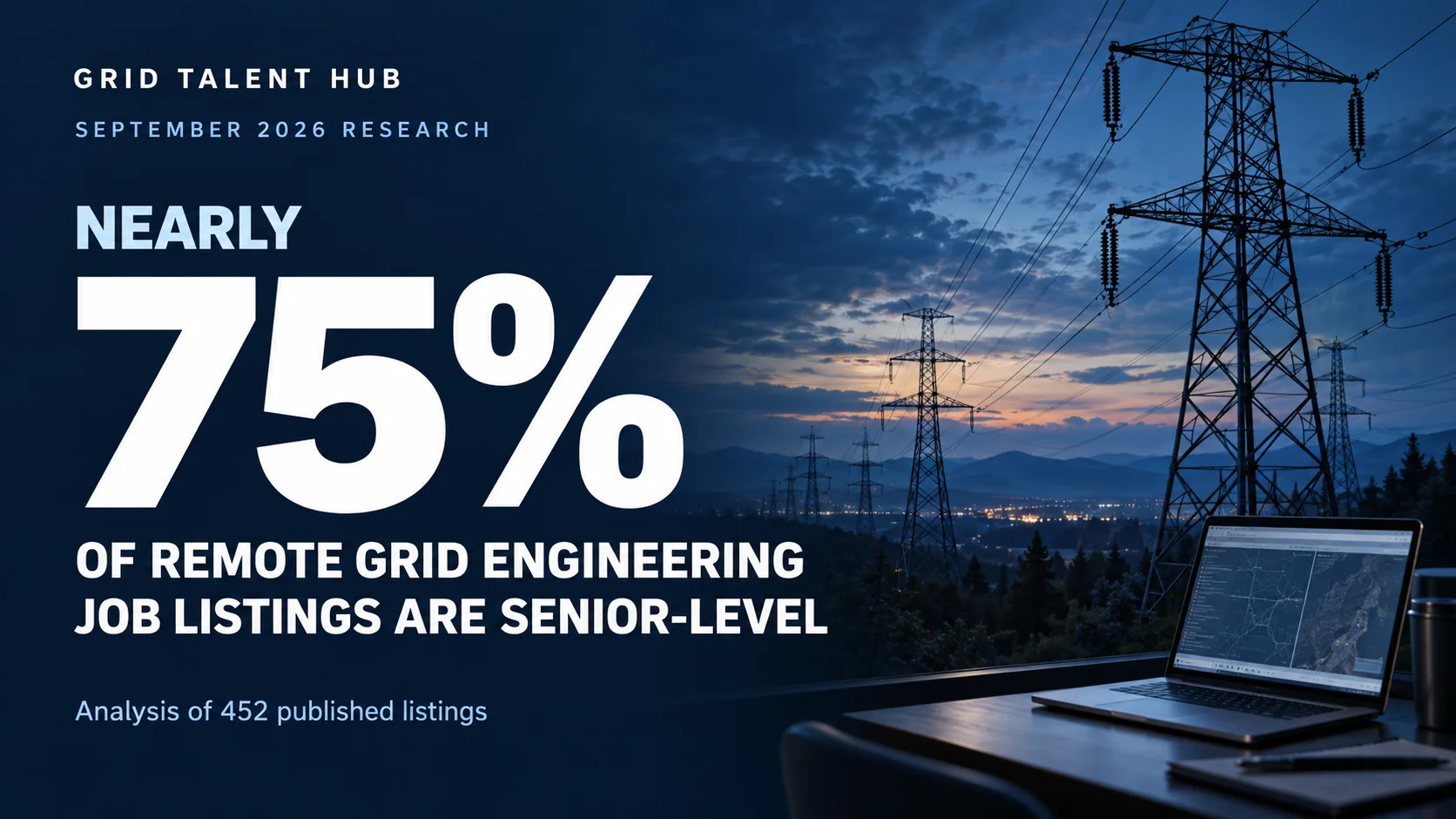
And among all 66 fully remote listings, 62 were categorized as mid-level or senior.
In other words, nearly 94% of fully remote grid engineering listings targeted mid-level or senior professionals.
The implications are particularly relevant for graduates evaluating their first engineering role.
Candidates entering fields such as substation design and protection engineering may have substantially fewer location-flexible opportunities than experienced professionals in the same broader industry.
One possible explanation is that early-career engineers benefit from direct exposure to equipment, field conditions, design reviews, and experienced colleagues.
The listings themselves do not explain employers' reasoning, but the difference in work arrangements is substantial.
3. Transmission engineering is far more remote-friendly than substation engineering
The availability of remote work also differs sharply by discipline.
Grid Talent Hub compared selected engineering categories within the published listings.
Engineering category | Listings | Fully remote | Remote share |
|---|---|---|---|
Transmission engineering | 86 | 32 | 37.2% |
Substation engineering | 81 | 4 | 4.9% |
Protection & control engineering | 44 | 3 | 6.8% |
Distribution engineering | 36 | 2 | 5.6% |
Relay technician | 72 | 0 | 0% |
Categories are based on listing classifications and may overlap; a single job can belong to multiple categories.
The difference is especially pronounced between transmission and substation engineering.
A listing categorized as transmission engineering was approximately 7.5 times as likely to be marked fully remote as one categorized as substation engineering.
These findings suggest that the specific engineering discipline may be at least as important as seniority when evaluating location flexibility.
They also illustrate why a single industry-wide remote-work percentage can conceal important differences among career paths.
For candidates, distinctions between transmission, substation, and protection engineering can affect not just technical responsibilities, but where the job can be performed.
4. What employers are offering in salary ranges
Compensation provides another perspective on the experience gap.
Of the 500 published listings, 210 contained complete, usable annual salary ranges after filtering the data.
Across those positions, the median advertised salary-range midpoint was approximately $126,400 per year.
Breaking the figures down by seniority:
Seniority | Listings with usable salary ranges | Median advertised range midpoint |
|---|---|---|
Entry-level | 12 | $78,300 |
Mid-level | 51 | $108,290 |
Senior | 141 | $127,700 |
The gap between the entry-level and senior figures was approximately $49,400.
These are advertised salary-range midpoints, not verified salaries earned by employees.
They should also be interpreted carefully: only 42% of the published listings contained complete usable annual ranges, and disclosure rates varied among employers and seniority groups.
Nevertheless, the data provides a useful directional view of advertised compensation within this specialized sample.
5. The technical skills appearing in grid engineering job listings
The analysis also examined the technical skill tags associated with the published positions.
While fundamental electrical engineering knowledge remains central, employers' listings reference a broad range of specialized design, protection, analysis, and programming competencies.
Skill or technical competency | Tagged listings | Share of all listings |
|---|---|---|
Substation design | 147 | 29.4% |
IEEE standards | 96 | 19.2% |
Protection & control engineering | 89 | 17.8% |
Protective relays | 86 | 17.2% |
Relay settings | 78 | 15.6% |
Python | 73 | 14.6% |
ETAP | 65 | 13.0% |
PSS/E | 47 | 9.4% |
PLS-CADD | 31 | 6.2% |
These figures represent skill-tag occurrences, not a mutually exclusive ranking or a validated measure of employer demand. Individual listings can contain multiple skill tags.
One notable result is the presence of Python in 73 listings, or 14.6% of the published sample.
This illustrates how programming and software-based analysis are appearing alongside traditional power engineering competencies.
For students and early-career professionals, the data offers a practical way to evaluate which technical areas may be worth exploring alongside foundational engineering coursework.
It also provides employers and universities with a starting point for discussing how technical training aligns with the competencies appearing in job advertisements.
6. What the findings mean for the grid engineering workforce
Three questions emerge from the data.
First, how can employers build a stronger early-career pipeline?
When more than half of published listings target senior professionals, employers may need to consider whether junior engineering opportunities, training programs, and mentorship structures are sufficient to develop future technical leaders.
Second, can flexibility become a recruiting advantage?
Only 13.6% of entry-level listings offered hybrid or fully remote arrangements.
Employers able to provide meaningful flexibility while maintaining the hands-on development required for new engineers may have an opportunity to differentiate their openings.
Third, are students receiving exposure to the specialized skills that appear in actual hiring requirements?
Substation design, relay protection, power system modeling, and technical software all appear in the analyzed listings.
Closer coordination between engineering employers and academic programs could help prospective engineers understand the technical skills relevant to different career paths.
Conclusion: the grid needs experienced engineers—but it also needs a path to develop them
The October 2026 Grid Talent Hub snapshot reveals a hiring market heavily weighted toward experienced professionals.
More than half of published opportunities were categorized as senior-level, remote work was concentrated among mid-level and senior roles, and flexibility differed dramatically across disciplines.
The findings do not prove a national workforce shortage, nor do they establish that these patterns are worsening over time.
But they do raise a question worth examining:
If so much of today's specialized grid engineering recruitment targets established professionals, what mechanisms will develop tomorrow's senior engineers?
That question matters to engineering employers, utilities, universities, professional associations, and anyone planning a career in electric power infrastructure.
About the data and methodology
This report is based on Grid Talent Hub's job-listing export analyzed on October 8, 2026.
The underlying dataset contained 864 records. The analysis excluded 363 expired records and one draft record, leaving 500 published listings representing 121 named employers.
Listings were classified using the export's seniority, work-arrangement, discipline, and skills fields. Some discipline and skill categories overlap.
Salary analysis included 210 listings with valid annual minimum and maximum figures standardized into U.S. dollars. The salary-range midpoint was calculated for each qualifying listing, followed by the median within each reported group. Hourly and monthly postings, incomplete ranges, and an anomalous annual value were excluded.
The analysis counts job listings, not hires or unique vacancies independently confirmed with employers. A company may contribute multiple listings. The ten most represented employers accounted for 57.6% of the published sample.
Because Grid Talent Hub is a specialized job-board dataset rather than a probability sample of all employers, results should not be generalized to the entire U.S. labor market. This is a single-date snapshot, not a longitudinal trend study.
Source: Grid Talent Hub, October 2026 Grid Engineering Hiring Snapshot.
Researchers, journalists, and industry publications may cite these findings with attribution to Grid Talent Hub and a link to this report.