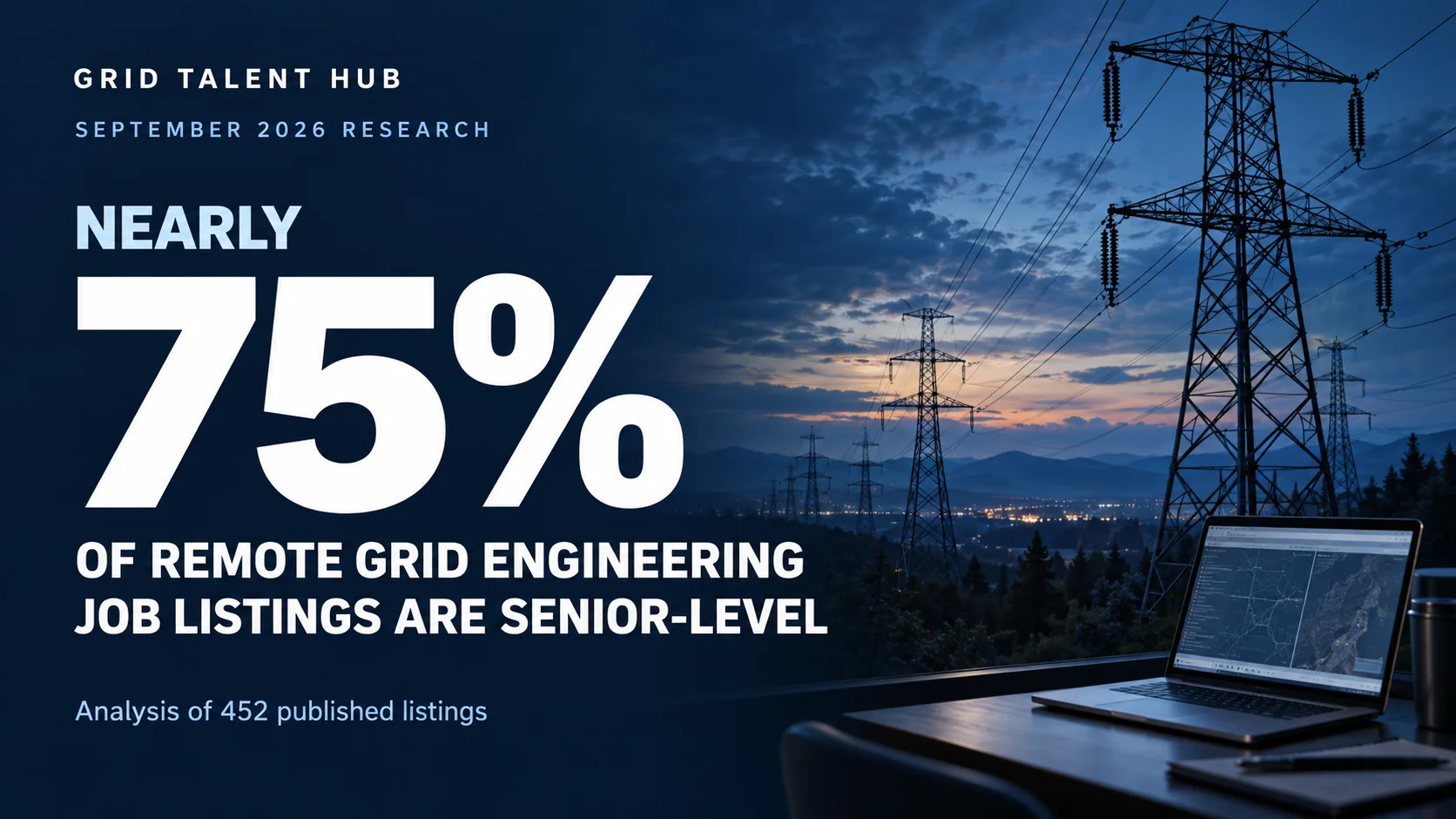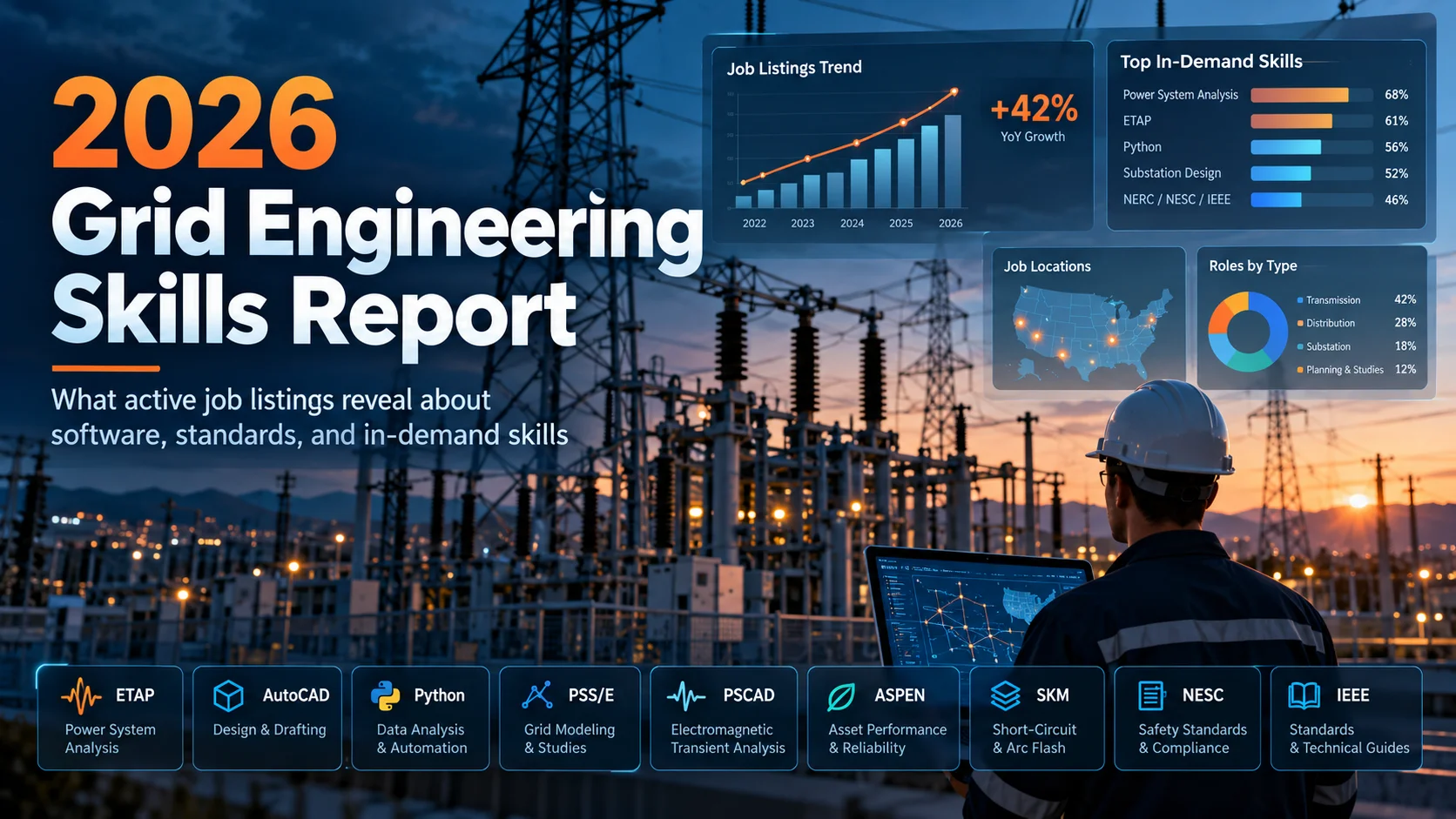
An analysis of 364 distinct active grid engineering jobs from 137 employers reveals which software platforms, technical skills, standards, and protocols are appearing most often in the power industry job market.
What software should a power systems engineer learn? Is ETAP more valuable than PSS/E? How important is Python in grid engineering? And does the answer change depending on whether you work in transmission, substations, protection and control, or distribution?
To answer those questions with job-market data rather than opinion, Grid Talent Hub analyzed active grid and power engineering job postings across the United States.
The underlying dataset contained 500 currently published job postings from 137 employers as of October 2, 2026. Because some companies advertise the same position across multiple locations, repeated employer/job-title combinations were removed for this analysis.
That left 364 distinct active roles.
The results show that there is no single "power engineering software stack." The tools employers mention change significantly by discipline. ETAP and AutoCAD have the broadest reach across the market, while tools such as PLS-CADD, PSS/E, PSCAD, ASPEN, CYME, and CAPE become much more important within particular specialties.
Python also appears frequently enough to stand alongside several traditional power-system engineering platforms—and is particularly notable in entry-level and transmission-related roles.
Key Findings
ETAP was the most frequently identified engineering software, appearing in 72 of 364 distinct jobs, or 19.8%.
AutoCAD was close behind at 18.7%, showing that traditional design software remains highly relevant in grid engineering.
Python appeared in 12.9% of postings, ahead of several established power-system-specific platforms.
Transmission engineering stood out for its specialized software mix: 38.0% of transmission-tagged roles mentioned PLS-CADD, while 25.3% mentioned Python and 24.1% mentioned PSS/E.
Among protection and control roles, ETAP and ASPEN were particularly prominent.
Software frequently appeared in clusters rather than alone. For example, 44 of the 45 roles mentioning SKM PowerTools also mentioned ETAP.
Technical standards matter almost as much as software: NESC appeared in 23.9% of the distinct jobs analyzed, while IEEE standards appeared in 16.8%.
Among 47 entry-level roles, Python was the most frequently identified software skill, appearing in 17.0%.
The Most Mentioned Software in Grid Engineering Jobs
ETAP led the overall dataset, appearing in nearly one out of every five distinct roles analyzed.
AutoCAD followed closely.
Python ranked third, ahead of specialized platforms including PSS/E, ASPEN and PSCAD.
Software or Tool | Distinct Jobs | Share of 364 Jobs |
|---|---|---|
ETAP | 72 | 19.8% |
AutoCAD | 68 | 18.7% |
Python | 47 | 12.9% |
SKM PowerTools | 45 | 12.4% |
PSS/E | 43 | 11.8% |
ASPEN | 40 | 11.0% |
PSCAD | 35 | 9.6% |
MicroStation | 32 | 8.8% |
PLS-CADD | 30 | 8.2% |
GIS / ArcGIS | 24 | 6.6% |
CYME | 21 | 5.8% |
EasyPower | 20 | 5.5% |
CAPE | 18 | 4.9% |
PowerWorld | 17 | 4.7% |
PSLF | 17 | 4.7% |
EMTP | 17 | 4.7% |
MATLAB | 17 | 4.7% |
These percentages should not be interpreted as the percentage of engineers who use each tool. They measure how frequently the tools appeared in the structured skill data associated with active job listings.
A job can also mention several platforms, meaning the percentages do not add to 100%.
ETAP Has the Broadest Reach Across the Grid Job Market
ETAP's position at the top of the dataset is notable because its demand was not confined to one narrow job family.
Among the 202 distinct roles tagged for power systems engineering, 25.2% mentioned ETAP.
ETAP also appeared in 22.4% of substation engineering roles and 30.2% of protection and control engineering roles in the dataset.
That makes ETAP less of a specialty-specific platform than tools such as PLS-CADD or CYME. It appears across electrical studies, protection, substations, power systems analysis and related consulting work.
SKM PowerTools showed a similar pattern, although at a lower overall frequency.
One of the most interesting relationships in the dataset is that 44 of the 45 jobs mentioning SKM PowerTools also mentioned ETAP.
That does not necessarily mean an employer expects candidates to know both. Listings frequently identify multiple acceptable or related platforms. But it does show how closely the two appear together in the current labor market.
AutoCAD Remains One of the Most Transferable Grid Engineering Skills
Despite the growth of highly specialized grid modeling tools, conventional engineering design software remains deeply embedded in hiring requirements.
AutoCAD appeared in 68 of 364 jobs, or 18.7%, making it the second-most frequently identified software platform in the study.
Its presence was also spread across disciplines.
Among jobs tagged as substation engineering roles, 23.5% mentioned AutoCAD. The figure was 22.8% for transmission engineering and 25.9% for distribution engineering.
MicroStation showed an especially strong relationship with AutoCAD.
All 32 roles in the sample that mentioned MicroStation also mentioned AutoCAD.
Again, that should not be interpreted to mean every job required proficiency in both. In many engineering environments, employers work with multiple design platforms or accept experience with comparable software.
The broader takeaway is that CAD proficiency remains relevant even as the grid becomes increasingly software-driven.
Python Has Become a Meaningful Grid Engineering Skill
Python was identified in 47 of the 364 distinct roles analyzed, representing 12.9% of the sample.
That put it ahead of PSS/E, ASPEN, PSCAD, MicroStation, CYME, MATLAB and several other specialized engineering applications in overall frequency.
Python was particularly prominent among jobs tagged for transmission engineering.
Of 79 transmission engineering roles, 20 mentioned Python, or 25.3%.
It also appeared in 15.3% of jobs tagged for power systems engineering.
Perhaps the most interesting result comes from entry-level postings.
There were 47 distinct jobs classified as entry-level in the deduplicated dataset. Python appeared in eight of them, or 17.0%, making it the most frequently identified software skill in that group.
PSS/E followed at 12.8%, while ETAP, SKM PowerTools and PSCAD each appeared in 10.6%.
The sample is relatively small, so these figures should not be treated as a definitive ranking of what every new engineer should learn. But they provide evidence that programming is no longer peripheral to the grid engineering job market.
It is appearing directly alongside traditional electrical engineering platforms.
The Software Stack Changes Dramatically by Discipline
An overall ranking can obscure one of the most important findings in the data: grid engineering software demand is highly discipline-specific.
The table below looks at jobs carrying several major specialty tags. Because a position can belong to more than one category, these groups overlap.
Job Category | Sample Size | Most Frequently Mentioned Tools |
|---|---|---|
Power Systems Engineering | 202 | ETAP 25.2%, AutoCAD 17.3%, SKM 15.8%, Python 15.3%, PSS/E 12.4% |
Substation Engineering | 85 | AutoCAD 23.5%, ETAP 22.4%, ASPEN 16.5%, CAPE 11.8%, SKM 10.6% |
Transmission Engineering | 79 | PLS-CADD 38.0%, Python 25.3%, PSS/E 24.1%, AutoCAD 22.8%, PSCAD 20.3% |
Protection & Control Engineering | 43 | ETAP 30.2%, ASPEN 23.3%, AutoCAD 18.6%, SKM 16.3%, EasyPower 14.0% |
Distribution Engineering | 27 | AutoCAD 25.9%, GIS 25.9%, CYME 14.8%, SKM 11.1%, MicroStation 11.1% |
Controls Engineering | 30 | Python 23.3%, ETAP 10.0%, AutoCAD 6.7%, PSS/E 6.7%, PowerWorld 6.7% |
The differences are substantial.
For transmission engineers, PLS-CADD dominates the specialty-specific results.
For distribution roles, GIS and CYME become much more relevant.
For protection and control, ETAP and ASPEN rise toward the top.
For broader power systems jobs, the toolset becomes more diversified across ETAP, SKM, Python, PSS/E and PSCAD.
This helps explain why asking for the single "best software for power engineers" can be misleading. The more useful question is which software appears most often in the type of grid engineering work someone wants to pursue.
PSS/E and PSCAD Frequently Appear Together
PSS/E appeared in 43 distinct jobs, while PSCAD appeared in 35.
They also showed substantial overlap.
Of the 35 roles mentioning PSCAD, 28 also mentioned PSS/E.
That means 80% of PSCAD-tagged postings in this sample also identified PSS/E.
The same pattern appears elsewhere in the dataset.
Fourteen of the 17 jobs mentioning MATLAB also mentioned Python.
All 18 jobs mentioning CAPE also mentioned ASPEN.
These relationships reinforce an important point about grid engineering hiring: employers often describe families of related analytical tools rather than one isolated platform.
Specific software experience can still matter, but familiarity with the underlying engineering analysis appears across multiple platforms.
Software Isn't the Only Technical Signal Employers Are Sending
The dataset also reveals which engineering activities appear repeatedly in active job postings.
Technical Skill | Distinct Jobs | Share |
|---|---|---|
Power Systems Engineering | 116 | 31.9% |
Substation Design | 111 | 30.5% |
Protective Relaying | 63 | 17.3% |
Arc Flash Analysis | 46 | 12.6% |
Short-Circuit Analysis | 45 | 12.4% |
Protection Coordination Studies | 42 | 11.5% |
Relay Settings | 41 | 11.3% |
High-Voltage Design | 30 | 8.2% |
Load-Flow Studies | 30 | 8.2% |
Transmission Line Engineering | 29 | 8.0% |
Fault Analysis | 23 | 6.3% |
Interconnection Studies | 18 | 4.9% |
The combination of software and engineering fundamentals is important.
ETAP appearing in a job posting is less informative without understanding the work the platform supports: short-circuit studies, protection coordination, load flow, arc flash analysis, equipment evaluation and other electrical studies.
Likewise, knowing PSS/E or PSCAD is most valuable in the context of understanding transmission networks, power flow, dynamic behavior and grid studies.
The job data suggests that software proficiency is generally attached to a broader engineering capability rather than treated as a standalone skill.
NESC and IEEE Standards Are Among the Most Common Technical Requirements
Standards and communication protocols also appear frequently enough to deserve attention.
Standard or Protocol | Distinct Jobs | Share |
|---|---|---|
NESC | 87 | 23.9% |
IEEE Standards | 61 | 16.8% |
Modbus | 32 | 8.8% |
NEC | 30 | 8.2% |
ANSI Standards | 27 | 7.4% |
NERC Standards | 26 | 7.1% |
IEC 61850 | 25 | 6.9% |
DNP3 | 23 | 6.3% |
IEC Standards | 17 | 4.7% |
FERC Requirements | 12 | 3.3% |
NERC CIP | 6 | 1.6% |
NESC was the standout, appearing in nearly one-quarter of the jobs analyzed.
The prominence of Modbus, IEC 61850 and DNP3 also illustrates the overlap between traditional electrical engineering and increasingly digital substation and grid-control environments.
For engineers interested in SCADA, automation or protection, understanding communication protocols may be nearly as relevant to career development as learning another modeling platform.
What the Data Says About Entry-Level Engineers
One of the more surprising findings is how quickly specialized software begins appearing in job postings.
Among the 47 distinct entry-level roles in the study, Python appeared in 17.0%, PSS/E in 12.8%, and ETAP, SKM PowerTools and PSCAD each appeared in 10.6%.
That does not mean an entry-level candidate must master five different platforms.
Instead, it shows that employers are already exposing early-career engineers to the same ecosystem of tools used throughout the power industry.
For students and engineers deciding where to spend limited learning time, the data also suggests that specialization matters.
Someone pursuing transmission planning may encounter a very different software environment from someone pursuing distribution design, protection and control, substations or SCADA.
There is no universal grid engineering software stack.
There are several.
What This Means for the Grid Engineering Workforce
The modern grid engineering job market combines traditional electrical engineering fundamentals with increasingly specialized software and digital skills.
AutoCAD remains highly relevant. ETAP appears across multiple engineering disciplines. PSS/E and PSCAD remain important in system studies. PLS-CADD stands out in transmission. CYME and GIS become more prominent in distribution. ASPEN and CAPE appear heavily in protection-related work.
At the same time, Python has become common enough to compete with many established industry platforms in job-posting frequency.
That combination is likely the clearest takeaway from the data.
Grid engineering is not becoming less electrical-engineering focused. Instead, the software layer surrounding the physical grid is becoming increasingly important.
The engineers represented by today's job postings are being asked to understand both.
Methodology
Grid Talent Hub analyzed its grid engineering job dataset on October 2, 2026.
The dataset contained 694 total records: 500 currently published jobs, 193 expired jobs and one draft listing. Only currently published jobs were considered for the active-job analysis.
Those 500 published listings represented 137 employers.
To reduce distortion from companies advertising the same position in several geographic markets, repeated combinations of the same employer and normalized job title were counted once. This produced a research sample of 364 distinct active roles.
Software, standards and technical skills were calculated from the structured skill data associated with those jobs. A listing can mention multiple skills, so percentages do not sum to 100%.
Specialty analyses use job-category tags and can overlap. For example, the same position may be categorized as both power systems engineering and transmission engineering.
The study measures the frequency with which skills appear in job listings. It does not measure actual software usage among all practicing engineers, proficiency levels, or the relative importance an employer assigns to each skill.
The dataset represents jobs indexed by Grid Talent Hub and should be viewed as a snapshot of the market rather than a census of every grid engineering vacancy in the United States.
About the Data
Grid Talent Hub tracks careers across power systems, protection and control, substations, transmission, distribution, SCADA, grid automation and related electrical engineering specialties.
Researchers, universities, employers and publications are welcome to reference statistics from this report with attribution and a link to Grid Talent Hub.
Source: Grid Talent Hub analysis of active grid engineering job postings, October 2026.