Updated by
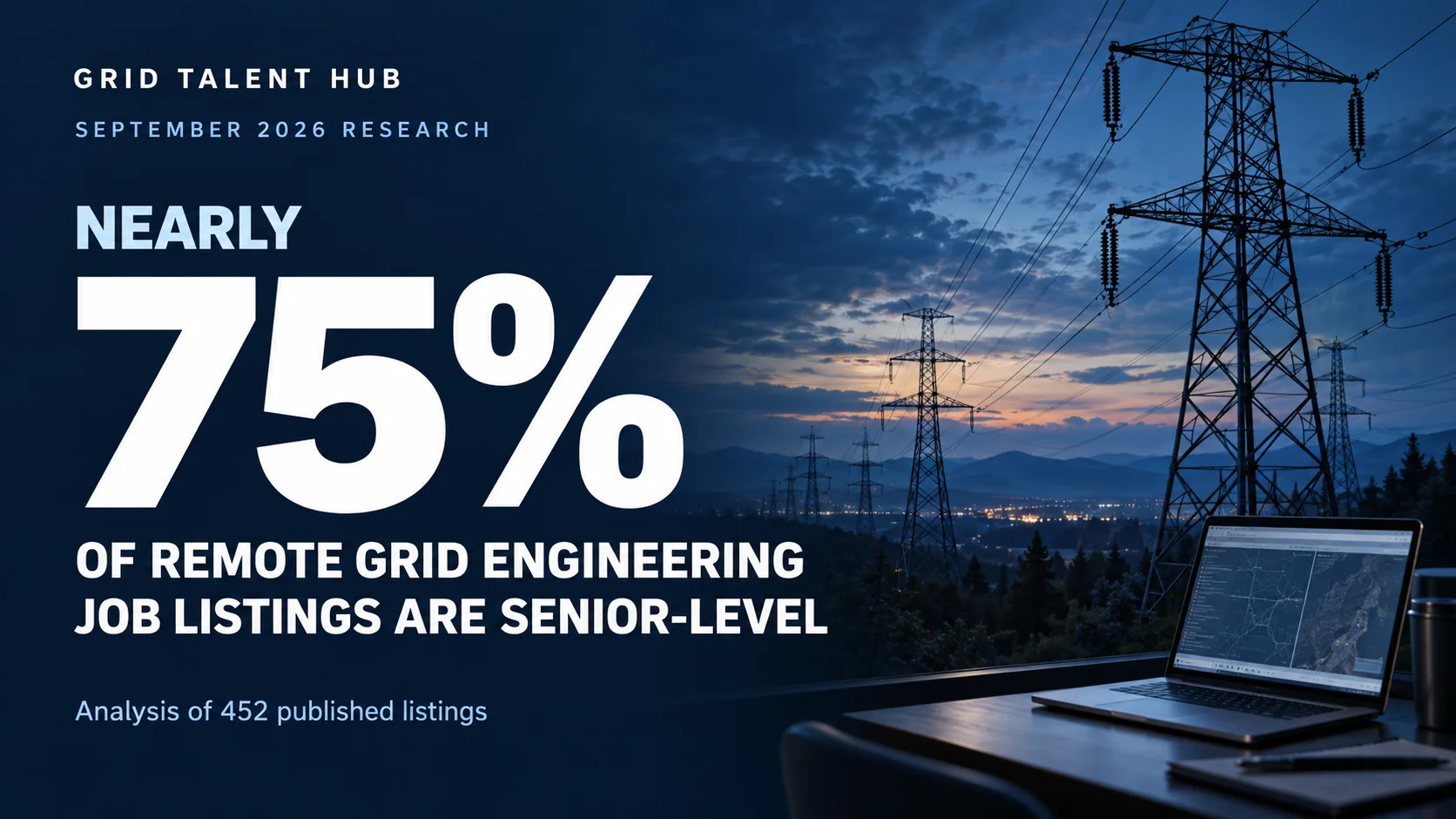
Nearly three in four remote grid engineering job listings were senior-level in a September 2026 analysis by Grid Talent Hub.
The specialized job board examined 452 published listings, including 91 classified as remote. Of those remote listings, 68 were labeled senior-level, representing 74.7%.
The concentration remained similar after consolidating matching repeated records: senior roles still accounted for 74.2% of remote records.
Key findings
74.7% of remote listings were senior-level, compared with 58.0% of all listings.
26.0% of senior listings were classified as remote, versus 9.1% of entry-level listings.
49.3% of all listings were remote or hybrid, representing 223 of the 452 published listings analyzed.
These findings describe the listings represented on Grid Talent Hub, using the work-arrangement and seniority labels recorded in its dataset.
Remote availability differs by career level
Senior roles made up a majority of the overall sample, which partly explains their prominence among remote listings. However, the difference also appeared within career categories.
Approximately one in four senior listings was classified as remote. For entry-level listings, the figure was approximately one in eleven.
Career level | Total listings | Remote listings | Share classified as remote |
|---|---|---|---|
Entry-level | 44 | 4 | 9.1% |
Associate | 20 | 2 | 10.0% |
Mid-level | 125 | 17 | 13.6% |
Senior-level | 262 | 68 | 26.0% |
Director | 1 | 0 | 0.0% |
Total | 452 | 91 | 20.1% |
Percentages are calculated within each career category. Categories follow the dataset’s assigned labels and are not standardized experience bands. The single director listing is insufficient for conclusions about director-level work.
The sample shows an association between seniority and advertised remote availability. It does not establish whether experience itself explains the difference, or how much employer, discipline, geography, and job responsibilities contribute.
Hybrid positions account for another 29.2% of listings
Remote listings represented 20.1% of the sample. Another 29.2% were classified as hybrid.
Work arrangement | Listings | Share |
|---|---|---|
Remote | 91 | 20.1% |
Hybrid | 132 | 29.2% |
On-site | 229 | 50.7% |
Including hybrid positions expanded the sample of potentially suitable listings from 91 to 223, before accounting for a candidate’s location, qualifications, or other requirements.
For entry-level candidates, the dataset contained eight hybrid listings alongside four remote listings. Together, those represented 27.3% of entry-level listings.
Remote listings can still require travel or a specific location
The descriptions also show why a remote classification needs context.
Caterpillar’s Power Systems Engineer I – Electric Power listing described a U.S.-based remote position with 35–50% travel.
Two of the four listings classified as both entry-level and remote, both from Electric Power Engineers, specified that the work would be performed from Mexico.
The remote category therefore includes positions with materially different travel expectations and geographic restrictions. Its size should not be interpreted as the number of jobs available to someone seeking to work entirely from home in a particular country.
Methodology and limitations
Grid Talent Hub analyzed its September 2026 job export on September 13, 2026. The export contained 511 records. The analysis included 452 marked published and excluded 58 expired records and one draft.
The main figures count each published listing once and retain its recorded work-arrangement and seniority labels. Separate listings may contain repeated descriptions, including versions advertised for different locations. These are listing counts, rather than verified counts of unique vacancies or planned hires.
To check the effect of repetition, records were consolidated when their employer identifier, description, work arrangement, and seniority label matched. Whitespace was normalized before comparing descriptions. Records with conflicting labels remained separate.
This produced 373 records, including 89 classified as remote. Of those, 66 were senior-level, or 74.2%. After consolidation, remote availability within the senior and entry-level categories was 29.7% and 14.3%, respectively. The headline concentration remained similar, while the size of the difference between career levels changed.
The dataset represents one specialized job board and includes listings with different geographic restrictions. It is not a representative estimate of the U.S. labor market. Classification accuracy and continued availability were not independently verified for every listing.
Cite this research
Suggested citation: Grid Talent Hub. (2026, September). Nearly 75% of Remote Grid Engineering Job Listings Are Senior-Level.
When referencing these findings or using the chart, please credit Grid Talent Hub and link to this article. Include the September 2026 date and identify the findings as an analysis of listings on Grid Talent Hub.
Browse current grid engineering jobs.
Disclosure: This article was prepared with AI-assisted data analysis and drafting. The methodology and limitations above describe how the findings were calculated.